

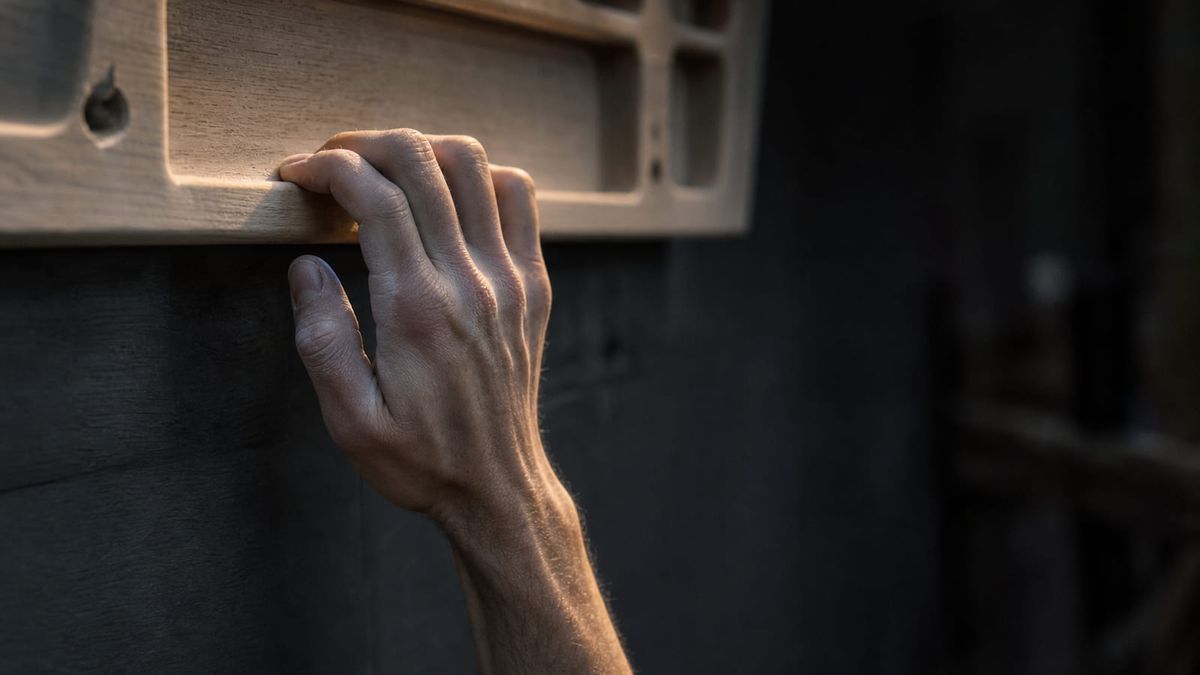
Between crimp and open hand, the half-crimp is the grip most boulderers should train. Open hand is the safest of the three positions and the least specific to small edges. The full crimp generates the most force and loads the A2 pulley the hardest, which makes it the highest-risk option. The half-crimp sits between them: trainable, strong on real holds, far safer than a closed crimp.
Key takeaways
- Open hand, or drag, keeps the PIP joint barely flexed, around 39° in motion-capture studies, and carries the lowest pulley strain of the three grips.
- The half-crimp holds the PIP at roughly 70° with the fingertips engaged and no thumb wrap, which makes it the best default training grip.
- The full crimp closes the PIP to 87–100° with the thumb locked over the index and the fingertip joint hyperextended: maximum force, maximum load.
- Vigouroux et al. (2006) measured 31.5× more A2 pulley force and 3.9× more A4 force in a full crimp than in an open hand, which is why full-crimp volume stays small.
The three grips, defined
Three positions cover nearly every hold you will ever touch, and what separates them is the angle at one knuckle. That knuckle is the PIP, the proximal interphalangeal joint, the middle joint of the finger. Every difference in force, feel and risk between the three grips follows from how far you bend it.
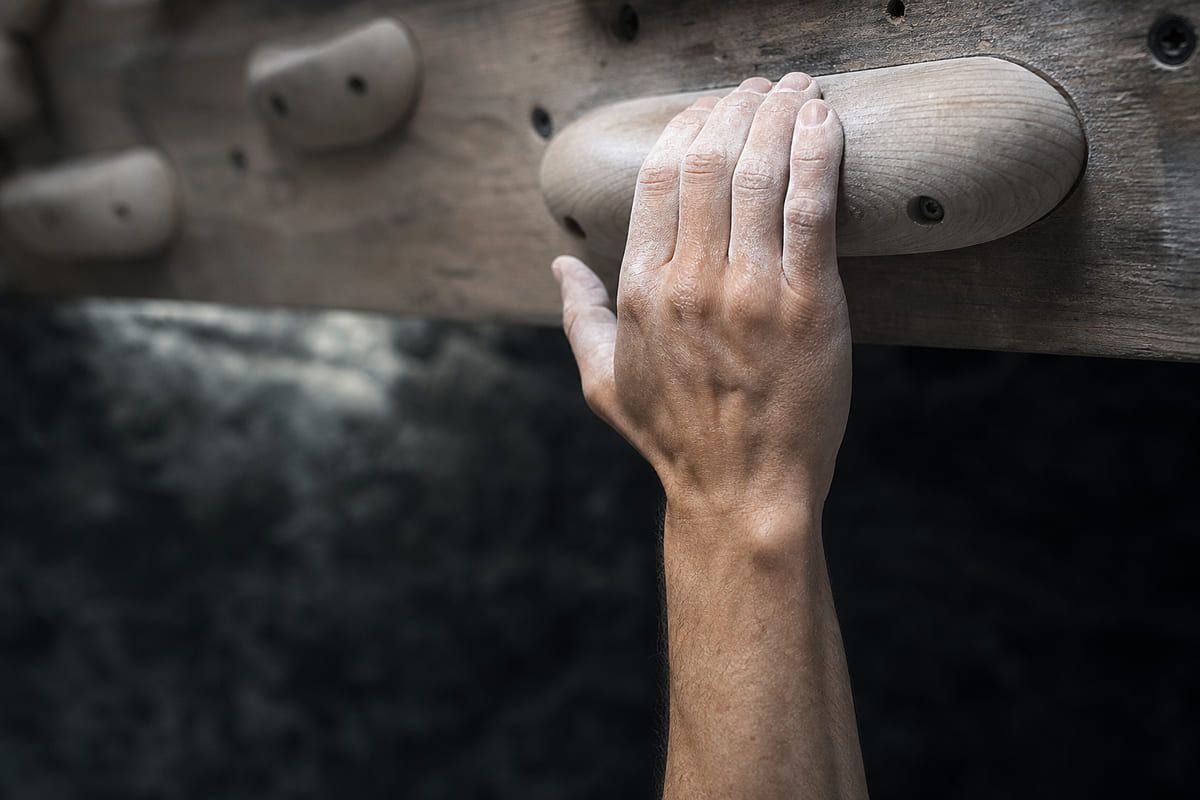
Open hand, also called drag, leaves the PIP barely flexed, around 39° in motion-capture studies. The fingers stay relatively straight, the fingertip presses down the line of the digit rather than around a corner, and the position carries the lowest pulley strain of the three. It feels weak on small edges because it is weak on small edges. You have given up the leverage that flexion buys you, and in exchange you get the gentlest loading pattern available.
The half-crimp takes the PIP to roughly 70°. The fingertips are genuinely engaged, the last joint stays flat instead of folding back, and the thumb stays off the index finger. That last detail is what makes it a half-crimp rather than a full one, and it is the part most climbers get wrong when they believe they are training half-crimp. This is the position most hangboard protocols assume.
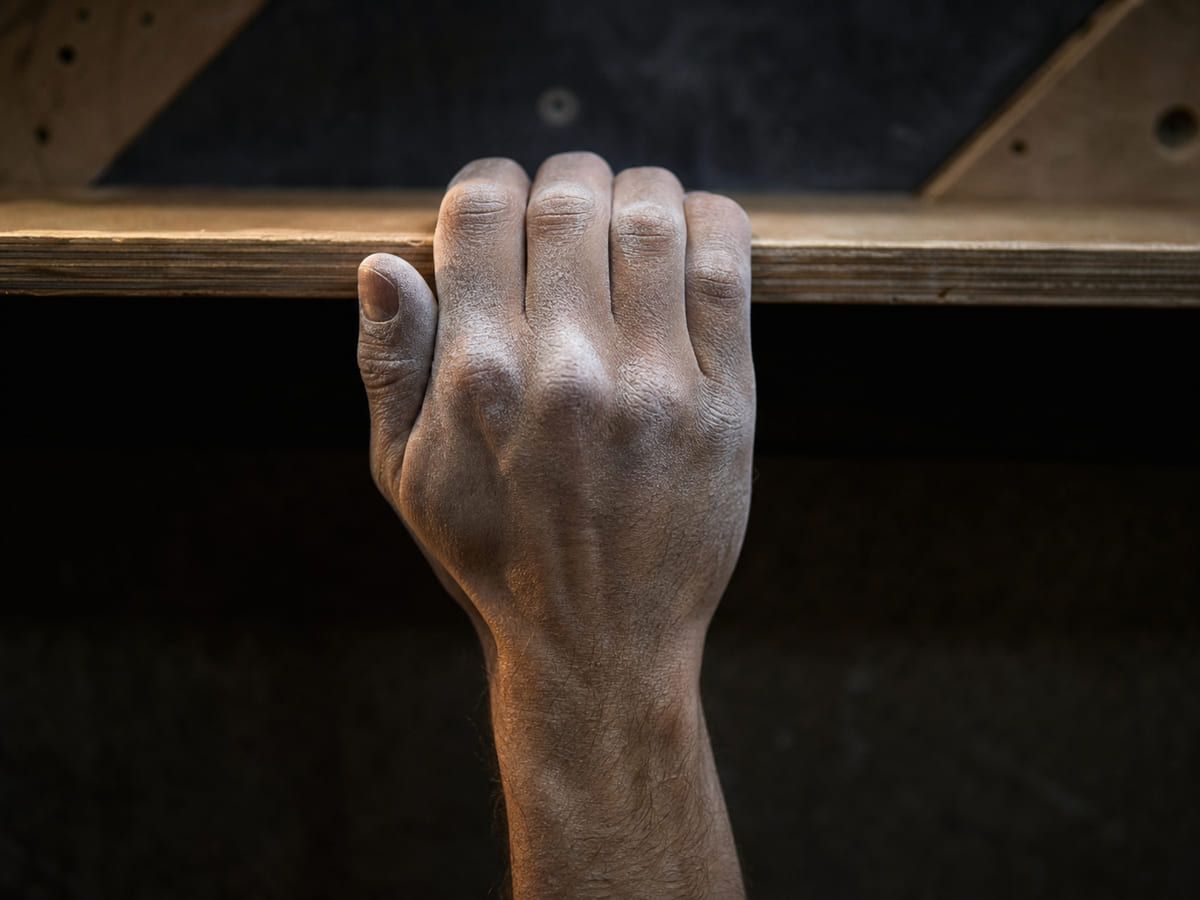
The full or closed crimp shuts the PIP down to 87–100°, hyperextends the fingertip joint (the DIP) and locks the thumb over the top of the index finger. The thumb is not decoration. It adds force to the stack and clamps the index in place, which is why the closed crimp is the strongest thing you can do on a tiny incut edge, and why so many climbers fall into it without ever deciding to. Maximum force and maximum load are the same position.
The common mistake is assuming you know which one you are using. Under load a half-crimp collapses toward drag as the fingers tire, and drag creeps back toward a crimp as you fight to stay on. Film one hangboard set from the side. It will tell you more about your grip than a season of guessing.
The biomechanics of risk
Pulley load rises with two things: how far the PIP is flexed, and how hard the fingertip pushes. In a full crimp both peak at the same moment, which is why the position is not merely a little more demanding than the others.
Vigouroux et al. (2006) put numbers on it with elite climbers. Against an open hand, a full crimp multiplied the force on the A2 pulley by 31.5 and the force on A4 by 3.9. Read that as a training decision rather than a scare statistic. Two hangs can put the same number on the scale and ask completely different things of the same finger, so grip position is a load variable in its own right, exactly like added weight or edge depth.
Work it through on a single hold. You take an edge open-handed and it feels marginal, so you close it down to buy a little more purchase, and the hold instantly feels better. Nothing about the hold changed and nothing about your bodyweight changed. What changed is a joint angle, and with it the multiplier sitting on the A2 pulley. The feedback a crimp gives you is that it is easier. The feedback it does not give you is what that costs.
The anatomy behind those numbers, how a tear is graded and how long it takes to come back, belongs to the article on finger pulley injuries. What matters here is the ranking, and the size of the gap at the end of it.
The other half of the picture is when ruptures actually happen. Not usually in the calm middle of a hang, but in eccentric events: a foot cuts from a full crimp, the body swings out, and the fingers are forced open while still producing maximum force. That is the highest multiplier meeting the fastest change in load, and it happens on steep boulder problems far more often than on a hangboard.
Fatigue stacks the odds twice. Tired fingers produce less force, so the same hold now demands a higher percentage of what you have left, and a tired climber instinctively reaches for the strongest position available. The last two attempts of a session are where the multiplier and the eccentric event tend to meet.
Which grip to train
Make the half-crimp your primary hangboard grip. It transfers to most of the edges you meet on plastic and on rock, it is repeatable enough that the numbers you log still mean something six weeks later, and it returns most of the strength of a closed crimp without the multiplier attached.
Add open-hand and drag work on purpose rather than by accident. Slopers and pockets are held open-handed, and if every session you run is half-crimp on an edge, you will be strong in one position and surprised in the other two. Open hand is also the sensible way to introduce an unfamiliar hold type or a new load, because the lowest-strain position is the one that leaves you room to be wrong.
Keep full-crimp training minimal, and reserve it for fingers with years of accumulated load behind them. The risk-to-reward is poor. You will use the closed crimp when a problem demands it whether you trained it or not, and you can build most of the underlying strength in a position that does not multiply A2 force by the same factor. Low volume, fresh fingers, bigger holds, or not at all.
Which protocol you run those grips through is a separate question. Max hangs, repeaters, edge size and load progression are covered in the complete hangboard guide. If you would rather load the same grips from the floor, with blocks and lifting edges, the five finger-strength exercises worth programming covers those.
One check before you add weight to anything: hold your working grip for the full duration at a load you know you can manage, and watch the fingertip joint. If it folds back into a closed crimp over the last two seconds, you are not training the grip you wrote in the log.
Comparison table
The whole argument fits in one table.
| Grip | PIP angle | A2 pulley load | Risk | Best for |
|---|---|---|---|---|
| Open hand / drag | ~39° | Baseline | Low | Slopers, pockets, warm-up |
| Half-crimp | ~70° | Moderate | Moderate | Default training grip |
| Full/closed crimp | ~87–100° | ~31.5× open hand | High | Tiny incut edges only |
The A2 column deserves a second look. Baseline to moderate to roughly 31.5× is not a gentle gradient, and the PIP column shows how little travel it takes to cross it: fewer than 50 degrees of movement at one knuckle separates the lowest-strain position from the highest-load one. Grip position is not a matter of style. It is a load setting.
The Risk column is relative, not absolute. A full crimp on a big hold with warm hands is not dangerous, and a half-crimp on a minimal edge at the end of a long session is not automatically safe. The column ranks the three positions against each other at the same load, which is the only comparison the biomechanics actually supports.
Read the Best for column as a job description rather than a ranking. Open hand has work to do on slopers, pockets and every warm-up you will ever do. The half-crimp has work to do in almost every training session. The full crimp has work to do on tiny incut edges, and close to nowhere else.
One thing the table cannot show is volume. All three grips draw on the same tissue, so full-crimp attempts on a board session and half-crimp hangs two days later are not separate accounts, they are one week of finger load. That accounting is what how often you can hangboard is really about.
Sources
- Vigouroux, L. et al. (2006). Journal of Biomechanics, 39, 2583–2592.
Common questions
Is crimping bad?
Crimping is not inherently bad. The full crimp is the strongest position available on tiny incut edges, and sometimes it is the only grip that works. It is also the highest-load position measured for the A2 pulley, so treat it as an occasional tool used fresh and warm rather than a default training grip.
Best grip to train?
The half-crimp. It holds the PIP joint at roughly 70 degrees with the fingertips engaged and no thumb wrap, transfers to most edges on plastic and rock, and is far safer than the full crimp. Add open-hand or drag work for slopers and pockets, and keep full-crimp training minimal.
Is open hand always safer?
Generally yes at the A2 pulley, where an open hand is the baseline that every other grip is measured against. The qualifier is that the A4 pulley can be relatively stressed open-handed in some positions, so open hand is the lowest-strain grip overall rather than a guarantee that nothing can go wrong.
Should beginners full-crimp on the board?
No. Beginners should train the half-crimp and open hand on a hangboard and leave the full crimp for climbing moves that genuinely demand it. The closed crimp is the highest-load position for the A2 pulley, and fingers without years of accumulated load behind them have no reason to spend training volume there.

Jan Luther is a climber and the developer behind Boulder Trainer, the hangboard app with guided workouts, voice coaching and a habit tracker.
Keep reading
Pulley Injuries in Bouldering: Signs & Prevention
The pop you never want to hear. Here's how to recognize a finger pulley injury, why crimping multiplies the risk, and how to prevent and rehab it based on the research.
Hangboard Training: The Complete Guide for Boulderers
Everything a boulderer needs to train fingers safely: the three main hangboard methods, the research behind them, load and edge guidelines, and a beginner-safe first protocol.