

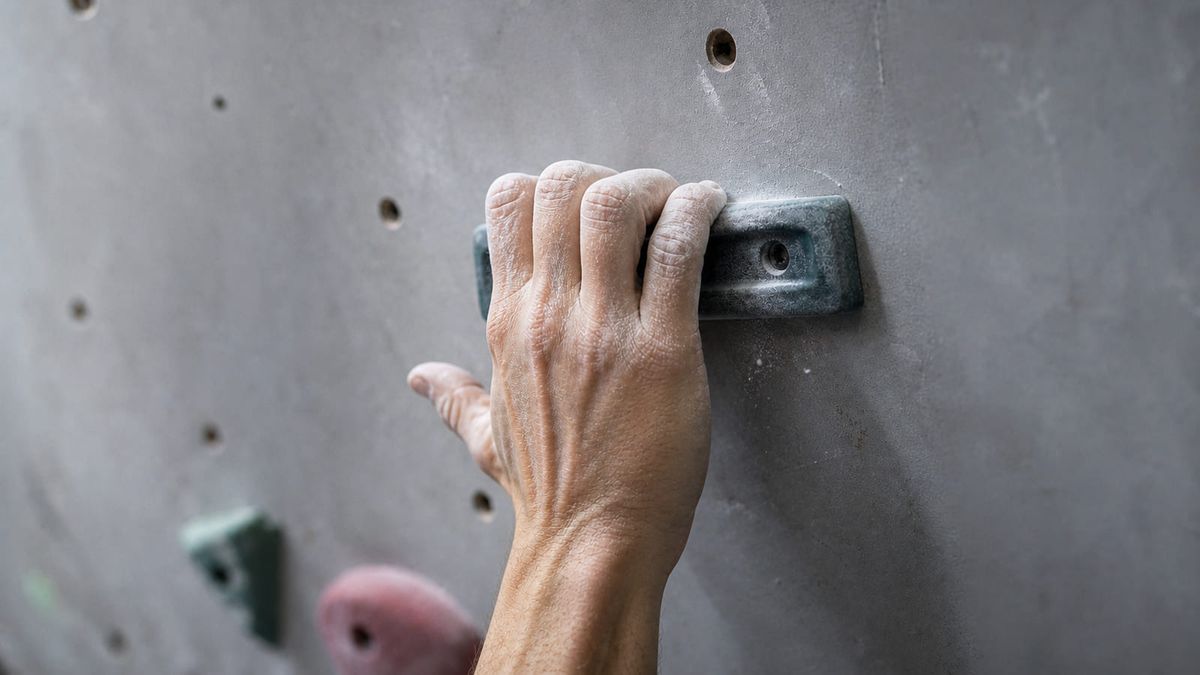
A pulley injury is the most common finger injury in climbing. It is a strain or tear of the annular bands that hold the flexor tendons against the bone, most often the A2, with the ring finger most affected. The classic mechanism is crimping, especially when a foot slips and the finger loads suddenly. A pop, sharp pain at the finger base or swelling means stop and get it assessed.
Key takeaways
- The full crimp multiplies force on the A2 pulley by 31.5× and on the A4 by 3.9× compared with an open hand (Vigouroux et al., 2006).
- Five annular pulleys, A1 through A5, hold the flexor tendons close to the bone; the A2 is both the most loaded and the most injured.
- Pulley injuries are graded I to IV (Schöffl): grade I is pain with full range of motion, grade IV is multiple ruptures and is mostly the surgical case.
- Return to climbing runs about 6 to 8 weeks for grade 1–2 and 3 months for grade 3, with protective taping for 3 months and 6 months respectively.
What a pulley is and why it fails
Five annular pulleys, A1 through A5, hold each finger’s flexor tendons tight against the bone. Think of them as the guides on a fishing rod: the tendon runs through them, and they keep it tracking along the curve of the bone instead of lifting away from it. When a pulley fails, the tendon bowstrings, standing visibly away from the finger under load.
The A2 sits at the base of the finger and is the most loaded and the most injured of the five. That is not bad luck. It sits closest to the joint doing the most work when you pull on a hold, so it takes the largest share of the force your flexors produce, on every hold, in every session.
The moment things go wrong is rarely the moment you expect. It is eccentric: a foot cutting, a hold breaking, a sudden release out of a crimp, anything that lengthens the finger while it is still fighting to stay closed. Friction dynamics inside the pulley spike the load in that instant, so the tissue sees a peak well above what the same hold produced a second earlier while you were static on it.
That mechanism explains a report every physio hears: “it felt fine on the move.” The hold was not the problem. The unplanned change in load was. It also explains why foot-off, dynamic finger training sits in a different risk category from static hanging, which is the argument running through the comparison of campus boards and hangboards.
The crimp connection
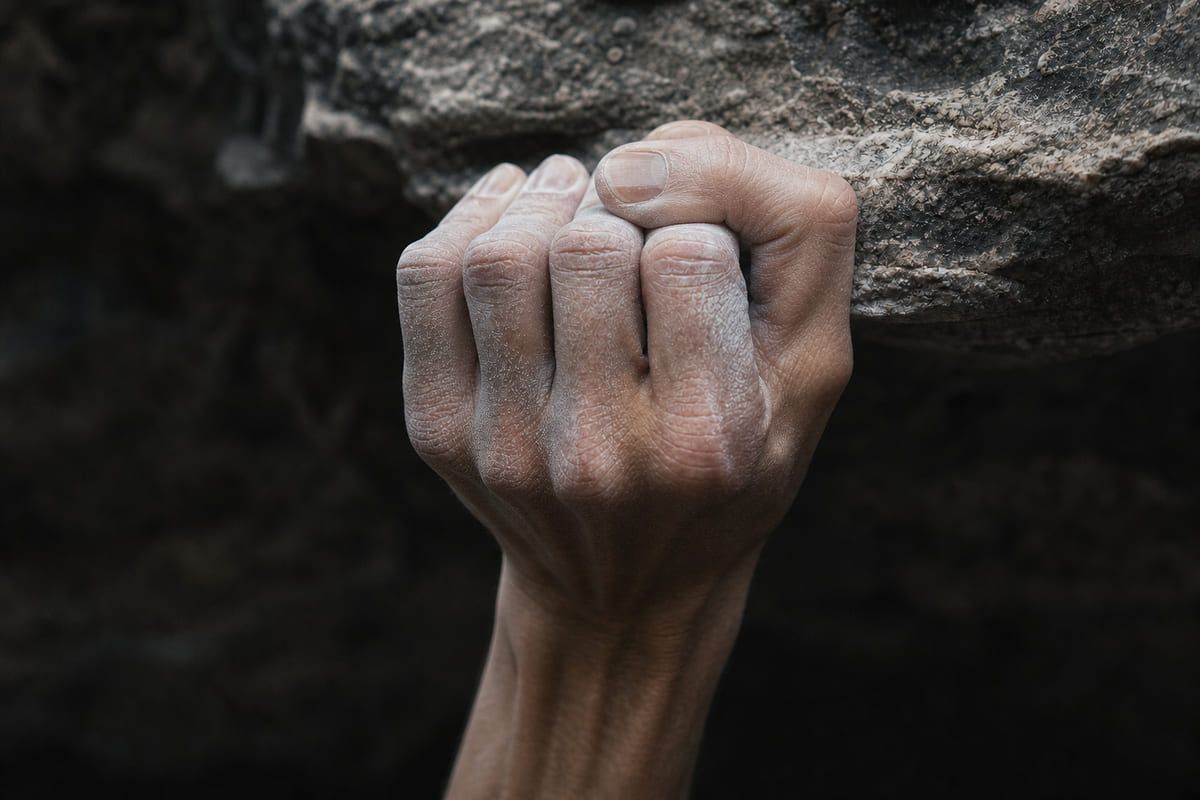
The full crimp raises force on the A2 pulley 31.5× and on the A4 3.9× compared with open-hand gripping. Vigouroux and colleagues (Journal of Biomechanics, 2006) produced those figures studying elite climbers at the 5.13b level, and they are the single most useful numbers in climbing injury prevention.
Read them carefully, because the scale is easy to lose. An open hand at full effort and a full crimp at full effort are not two versions of the same load with a bit of difference between them. On the A2 they are roughly thirty times apart. The reason is joint geometry: the crimp folds the finger into a shape that presses the tendon hard against the pulley instead of letting it track smoothly along the bone. The joint angles behind each grip position works through the angles that produce it.
The highest-risk profile follows directly: crimp-heavy climbing, done tired, with dynamic movement. Each element adds something. Crimping supplies the multiplier, fatigue degrades the grip you choose and the foot placement you make, and dynamic movement supplies the sudden loading the pulley handles worst.
The common mistake is to read 31.5× as “crimping is bad.” It is not, and you cannot climb hard without it. The number is about dose. Crimping is a skill worth training and a load worth rationing, which means capping how much of your week is deliberate full-crimp work rather than avoiding the grip and then meeting it unprepared on a project.
Warning signs and grading
A pop, sharp pain over the pulley at the base of the finger, and swelling are the red flags. In severe cases the tendon bowstrings, standing away from the bone when you flex the finger against resistance. Any of those signs is a reason to stop climbing and get the finger imaged and assessed, not a reason to strap it up and finish the session.
The climbing-medicine literature grades these injuries I to IV, following Schöffl. The grade is what drives everything afterwards, including how long you are out and whether surgery is on the table.
| Grade | What it is | Return to climbing | Protective taping |
|---|---|---|---|
| I | Pain, no bowstringing, full ROM | ~6–8 weeks | 3 months |
| II | Partial tear | ~6–8 weeks | 3 months |
| III | Complete rupture of a single pulley | ~3 months | 6 months |
| IV | Multiple ruptures | Often surgical; individual | Set by the treating clinician |
You cannot grade your own finger, and that is the practical point of the table rather than a disclaimer bolted onto it. Grade I and grade II both present as pain at the base of the finger with a working hand, and they look the same from the outside. Only an examination, with imaging where it is warranted, separates them.
The mistake that costs the most time is the opposite of panic: no pop, full range of motion, so it must be nothing. Grade I is defined as pain without bowstringing and with full range of motion. A finger that hurts on crimps and moves normally is still a finger with something wrong in it, and climbing through that is how a strain becomes a tear.
Return-to-climbing timelines
Grade 1–2 injuries return to climbing at roughly 6 to 8 weeks, grade 3 at around 3 months, with protective taping for 3 months after a grade 1–2 and 6 months after a grade 3, per Schöffl and the 2022 BMC systematic review. Those are population figures. Your timeline is set by the person examining your finger.
The principle underneath the numbers matters more than the numbers. Recovery runs on progressive tissue loading: controlled, gradually increasing load is what rebuilds a pulley’s tolerance. Tape is an adjunct to that process, not a substitute for it. Complete rest past the early stage does not build anything, and a taped finger that never gets loaded arrives at week eight no stronger than it was at week two.
Grip selection is how you apply the load safely. Reintroduce half-crimp on big holds first, and full crimp on small edges last, only when the finger is free of pain and swelling at the previous step. That order exists for one reason: it puts the 31.5× multiplier at the end of the queue, when the tissue has already proven it tolerates everything below it. Structured low-intensity finger loading is the usual bridge between the two, and the guide to hangboard methods covers which protocols sit at that end of the intensity scale.
The common error is treating the timeline as a countdown. Six weeks is not a permission slip. If week six still hurts on a half-crimp, week six is not the week you full-crimp a small edge.
Prevention
Prevention comes down to warming up, managing total finger load, and rationing full-crimp volume. None of it is exotic, and all of it is boring enough that most climbers skip at least one part.
Warm up for 15 to 20 minutes before hard finger work, every session. A pulley is a band of connective tissue holding a tendon against bone, and connective tissue that has not been brought up to temperature is stiffer and less tolerant of a sudden load — which is precisely the load profile of the first hard move of a session.
Then count what your pulleys are actually absorbing across the week rather than counting board sessions, because they respond to the total and do not care which piece of equipment produced it; the weekly finger-load accounting goes through that accounting. And plan the recovery instead of waiting for it: a scheduled deload week is where the tissue catches up with the training.
Cap full-crimp work as a weekly quantity you decide in advance, not as a decision you make on the wall when you are tired. Build capacity in months, not weeks. Tendons and pulleys adapt more slowly than muscle does, so the load that feels comfortable to your forearms in week three of a block is not automatically a load your pulleys have caught up with.
Sources
- Vigouroux, L. et al. (2006). Journal of Biomechanics, 39, 2583–2592.
- Schöffl grading I–IV and return-to-sport timelines. BMC Sports Science, Medicine and Rehabilitation (2022)
Common questions
Did I tear a pulley?
A pulley injury is likely when a pop, swelling and sharp pain at the base of the finger arrive together, usually during a crimp or a foot slip. Only a hands-on exam and imaging can confirm the grade, so stop climbing on the finger and get it assessed by a doctor or physiotherapist.
Should I tape a pulley injury?
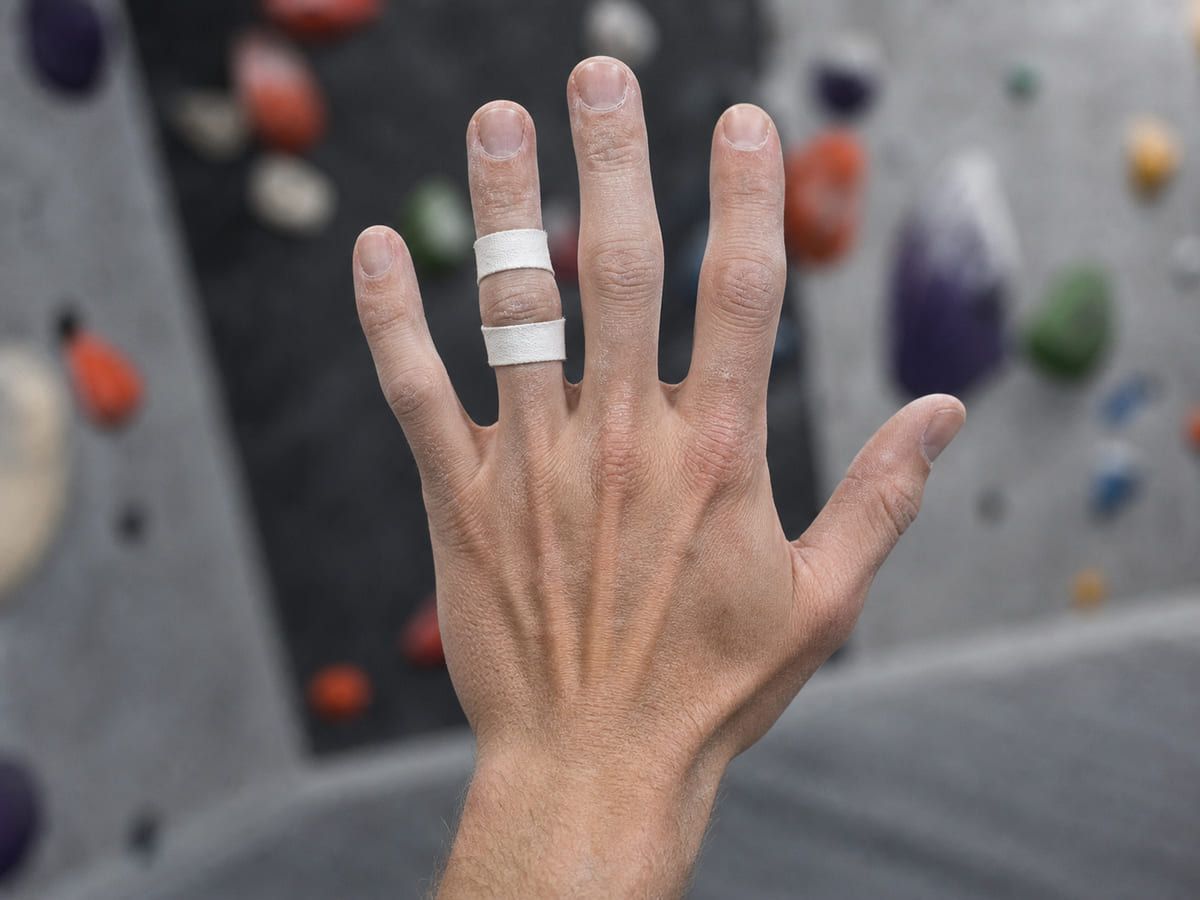
Taping is an adjunct during pulley rehab, not the treatment. The climbing-medicine literature reports protective taping for about 3 months after a grade 1–2 injury and 6 months after grade 3, alongside progressive loading. Tape supports the tendon while it is loaded; the loading itself is what rebuilds tissue tolerance.
When can I crimp again?
Full crimp comes last in a pulley rehab, and only when the finger is free of pain and swelling. The usual order is half-crimp on big holds first, then smaller holds, then full crimp, because the full crimp multiplies A2 pulley force 31.5× versus an open hand. Your clinician sets the timing.
Does a pulley injury need surgery?
Surgery is reserved mostly for grade IV pulley injuries, meaning multiple ruptures in the same finger. Grades I to III are usually managed without it, through progressive loading and protective taping, with return to climbing around 6 to 8 weeks for grades 1–2 and about 3 months for grade 3.

Jan Luther is a climber and the developer behind Boulder Trainer, the hangboard app with guided workouts, voice coaching and a habit tracker.
Keep reading
Open Hand vs Crimp: Which Grip Protects Your Fingers?
The full crimp puts up to 31.5× more force on your A2 pulley than an open hand. Here's how the three grips differ biomechanically — and which to train.
Hangboard Training: The Complete Guide for Boulderers
Everything a boulderer needs to train fingers safely: the three main hangboard methods, the research behind them, load and edge guidelines, and a beginner-safe first protocol.